Back
How Parked Cars Increase Traffic Problems in Indian Cities
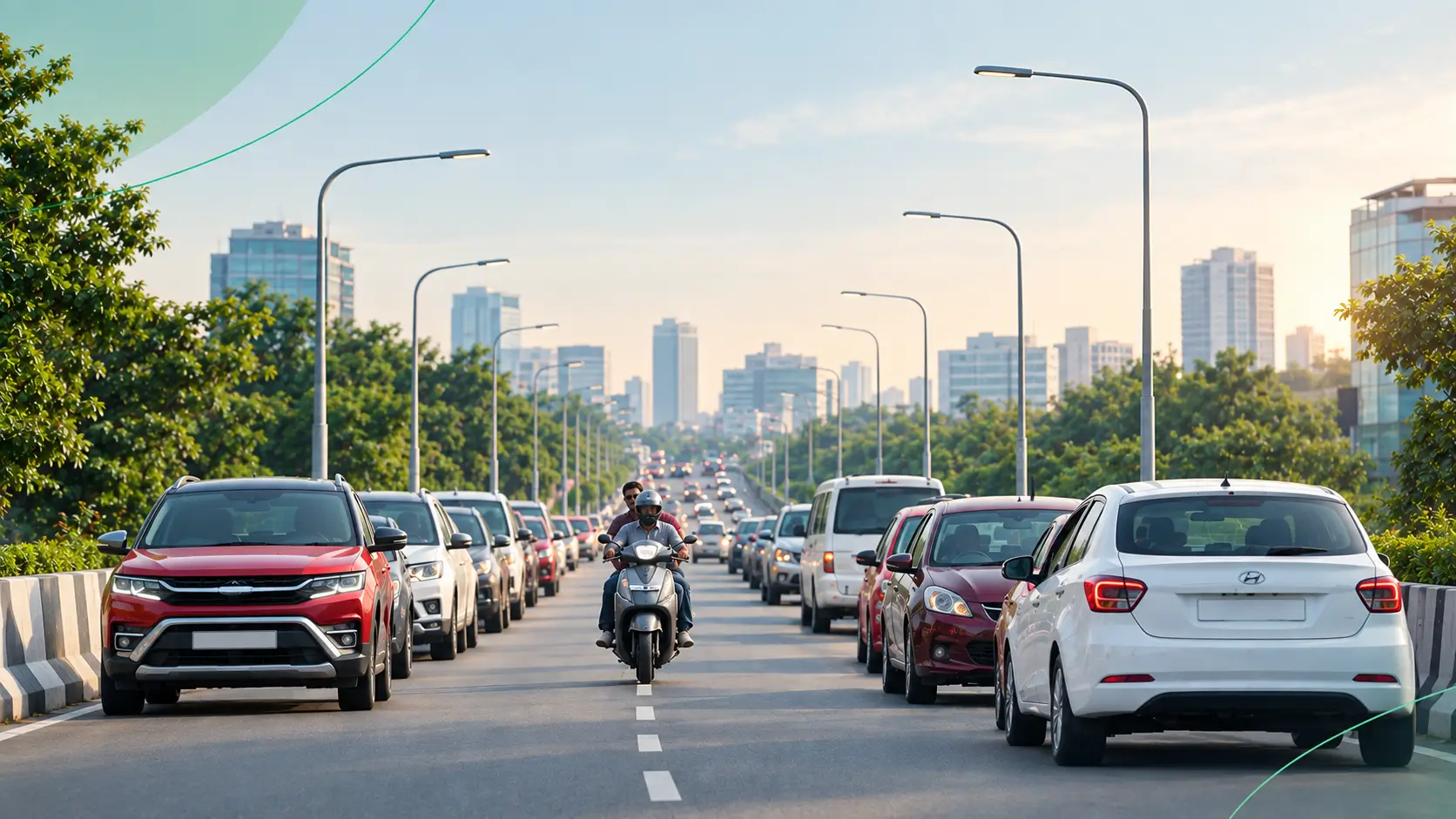
Understand how roadside parking, double parking and limited spaces can affect traffic movement in Indian cities.
Why Parked Cars Are Becoming a Traffic Problem in Indian Cities
Finding a parking space can be difficult in many Indian cities.
At the same time, roads are being used for parking.
Cars are often parked along busy roads, near markets, outside shops and around commercial areas. When too many vehicles stay on the road, less space is left for moving traffic.
This can slow down vehicles and make some roads difficult to use, especially during busy hours.
Parking is not the only reason for traffic problems in cities. But poorly managed parking can add to the problem.
How Do Parked Cars Affect Traffic?
A parked car takes up road space.
When several cars are parked along the same road, the space available for moving vehicles becomes smaller.
This can lead to:
Narrower roads
Slow-moving traffic
More vehicle waiting
Difficult turns
Blocked entry points
Problems for buses and other large vehicles
Less space for pedestrians
The problem becomes bigger when vehicles are parked for several hours.
Why Do People Park on Roads?
There are different reasons for on-street parking.
Some areas may not have enough parking spaces nearby.
Shops and offices may have customers and employees arriving throughout the day.
In some places, drivers may choose roadside parking because it is closer to their destination.
When proper parking is not available, vehicles may end up using road space.
A study published by the National Institute of Urban Affairs found that long-duration parking by shop owners and employees can take up a large part of available public parking space in some commercial areas. The study also found that vehicles can spill over into nearby lanes and restricted areas when parking space is not enough.
Parking Near Markets Can Create More Problems
Market areas can have high vehicle movement throughout the day.
Customers may stop for a few minutes, while shop owners and employees may keep their vehicles parked for much longer.
This means the same parking space may remain occupied for several hours.
When parking takes place along busy roads, moving vehicles have less space.
This can create slow traffic around the market.
Long-Term Parking and Short-Term Parking Are Different
Not every parked vehicle creates the same problem.
A customer who parks for 20 minutes uses a parking space differently from an employee who parks for eight hours.
If long-term users occupy spaces near shops and commercial areas throughout the day, short-term visitors may struggle to find a place to park.
They may then drive around looking for another space.
This adds more vehicle movement around the area.
Searching for Parking Can Add More Traffic
The problem does not stop with parked vehicles.
When drivers cannot find a parking space, they may continue driving around the area.
They may slow down near shops, check both sides of the road or enter nearby lanes looking for an open space.
A study from NIUA on parking in Mysuru found that many respondents took several minutes to find a suitable on-street parking space.
This means parking can affect traffic even when a vehicle is moving.
Double Parking Makes the Problem Worse
Double parking is another common issue.
It happens when a vehicle is parked beside another parked vehicle instead of inside a proper parking space.
This can leave very little space for moving traffic.
On a narrow road, even a few double-parked vehicles can create a bottleneck.
Other vehicles may have to slow down or move around them.
Parking Near Road Junctions
Parking close to a road junction can also create problems.
Vehicles waiting or parked near a turn can reduce visibility for drivers.
They can also make it harder for vehicles to turn.
Keeping junctions and important road sections clear is therefore important for smooth traffic movement.
Why Cities Need Better Parking Management
Building more roads is not always the only answer to traffic problems.
The available road and parking space also needs to be managed properly.
Cities can look at:
Off-street parking
Paid parking areas
Parking zones
Clear parking signs
Time limits
Better enforcement
Parking information systems
Digital parking management
The right solution depends on the area and the type of traffic.
How Smart Parking Can Help
Technology can help parking operators understand how parking spaces are being used.
A smart parking system can collect information about parking activity.
Depending on the system, it can help with:
Parking occupancy
Vehicle entry and exit
Parking duration
Available spaces
Parking records
Parking reports
This information can help operators understand where parking demand is high and how long vehicles usually stay.
Parking Management for Commercial Areas
Commercial areas need a different approach from office parking.
Customers may need short-term parking, while employees may need parking for several hours.
Separating these parking needs can make better use of the available space.
For example, long-term employee parking can be moved to a dedicated area while spaces closer to shops can be kept for customers.
This can reduce the pressure on busy roadside areas.
Can Parking Technology Solve Traffic Problems?
Technology alone cannot solve city traffic.
Road design, public transport, traffic signals, enforcement and parking availability also matter.
But better parking management can help reduce some problems caused by poorly organised parking.
Digital parking systems can give operators better information about vehicles and parking spaces.
That information can then be used to plan parking more effectively.
What Can Businesses Do About Parking?
Businesses can also affect traffic around their properties.
Offices, malls, hotels and commercial buildings can provide proper parking areas and manage vehicle entry and exit.
They can use systems such as:
RFID parking
ANPR
Boom barriers
Parking management software
Visitor management systems
Digital parking records
The aim is to keep vehicles inside designated parking areas instead of allowing them to block nearby roads.
Also read→
Types of Boom Barriers: Features, Uses and Applications
Frequently Asked Questions
Can parked cars cause traffic congestion?
Yes. Parked vehicles can reduce the road space available for moving traffic and can contribute to congestion, especially on busy or narrow roads.
Why is roadside parking a problem?
Roadside parking can reduce the space available for moving vehicles. It can also make turns, pedestrian movement and access to nearby properties more difficult.
Does searching for parking increase traffic?
It can. When drivers spend time looking for an available space, they continue moving through the area and may add to local traffic.
Is parking management important for Indian cities?
Yes. Proper parking management can help make better use of available parking and reduce problems caused by poorly organised or long-duration parking.
Can smart parking reduce traffic?
Smart parking can help manage parking information and vehicle movement, but it cannot solve every traffic problem. Road capacity, public transport, traffic management and other factors also affect congestion.
Conclusion
Parked vehicles may seem like a small part of the traffic problem, but they can noticeably affect busy roads.
When vehicles occupy road space for long periods, less space is available for moving traffic.
The problem can become worse when drivers have to search for parking or when vehicles are parked in restricted areas, near junctions or in multiple rows.
Better parking planning, proper parking spaces and digital parking management can help cities and businesses manage this problem.
The goal is simple: keep moving traffic moving and keep parked vehicles in the right place.
Looking for Better Parking Management?
Businesses with busy parking areas can use parking management systems to keep track of vehicles, parking spaces and entry and exit activity.
A well-planned parking setup can make better use of available space and reduce unnecessary pressure around busy roads.
Why Parked Cars Are Becoming a Traffic Problem in Indian Cities
Finding a parking space can be difficult in many Indian cities.
At the same time, roads are being used for parking.
Cars are often parked along busy roads, near markets, outside shops and around commercial areas. When too many vehicles stay on the road, less space is left for moving traffic.
This can slow down vehicles and make some roads difficult to use, especially during busy hours.
Parking is not the only reason for traffic problems in cities. But poorly managed parking can add to the problem.
How Do Parked Cars Affect Traffic?
A parked car takes up road space.
When several cars are parked along the same road, the space available for moving vehicles becomes smaller.
This can lead to:
Narrower roads
Slow-moving traffic
More vehicle waiting
Difficult turns
Blocked entry points
Problems for buses and other large vehicles
Less space for pedestrians
The problem becomes bigger when vehicles are parked for several hours.
Why Do People Park on Roads?
There are different reasons for on-street parking.
Some areas may not have enough parking spaces nearby.
Shops and offices may have customers and employees arriving throughout the day.
In some places, drivers may choose roadside parking because it is closer to their destination.
When proper parking is not available, vehicles may end up using road space.
A study published by the National Institute of Urban Affairs found that long-duration parking by shop owners and employees can take up a large part of available public parking space in some commercial areas. The study also found that vehicles can spill over into nearby lanes and restricted areas when parking space is not enough.
Parking Near Markets Can Create More Problems
Market areas can have high vehicle movement throughout the day.
Customers may stop for a few minutes, while shop owners and employees may keep their vehicles parked for much longer.
This means the same parking space may remain occupied for several hours.
When parking takes place along busy roads, moving vehicles have less space.
This can create slow traffic around the market.
Long-Term Parking and Short-Term Parking Are Different
Not every parked vehicle creates the same problem.
A customer who parks for 20 minutes uses a parking space differently from an employee who parks for eight hours.
If long-term users occupy spaces near shops and commercial areas throughout the day, short-term visitors may struggle to find a place to park.
They may then drive around looking for another space.
This adds more vehicle movement around the area.
Searching for Parking Can Add More Traffic
The problem does not stop with parked vehicles.
When drivers cannot find a parking space, they may continue driving around the area.
They may slow down near shops, check both sides of the road or enter nearby lanes looking for an open space.
A study from NIUA on parking in Mysuru found that many respondents took several minutes to find a suitable on-street parking space.
This means parking can affect traffic even when a vehicle is moving.
Double Parking Makes the Problem Worse
Double parking is another common issue.
It happens when a vehicle is parked beside another parked vehicle instead of inside a proper parking space.
This can leave very little space for moving traffic.
On a narrow road, even a few double-parked vehicles can create a bottleneck.
Other vehicles may have to slow down or move around them.
Parking Near Road Junctions
Parking close to a road junction can also create problems.
Vehicles waiting or parked near a turn can reduce visibility for drivers.
They can also make it harder for vehicles to turn.
Keeping junctions and important road sections clear is therefore important for smooth traffic movement.
Why Cities Need Better Parking Management
Building more roads is not always the only answer to traffic problems.
The available road and parking space also needs to be managed properly.
Cities can look at:
Off-street parking
Paid parking areas
Parking zones
Clear parking signs
Time limits
Better enforcement
Parking information systems
Digital parking management
The right solution depends on the area and the type of traffic.
How Smart Parking Can Help
Technology can help parking operators understand how parking spaces are being used.
A smart parking system can collect information about parking activity.
Depending on the system, it can help with:
Parking occupancy
Vehicle entry and exit
Parking duration
Available spaces
Parking records
Parking reports
This information can help operators understand where parking demand is high and how long vehicles usually stay.
Parking Management for Commercial Areas
Commercial areas need a different approach from office parking.
Customers may need short-term parking, while employees may need parking for several hours.
Separating these parking needs can make better use of the available space.
For example, long-term employee parking can be moved to a dedicated area while spaces closer to shops can be kept for customers.
This can reduce the pressure on busy roadside areas.
Can Parking Technology Solve Traffic Problems?
Technology alone cannot solve city traffic.
Road design, public transport, traffic signals, enforcement and parking availability also matter.
But better parking management can help reduce some problems caused by poorly organised parking.
Digital parking systems can give operators better information about vehicles and parking spaces.
That information can then be used to plan parking more effectively.
What Can Businesses Do About Parking?
Businesses can also affect traffic around their properties.
Offices, malls, hotels and commercial buildings can provide proper parking areas and manage vehicle entry and exit.
They can use systems such as:
RFID parking
ANPR
Boom barriers
Parking management software
Visitor management systems
Digital parking records
The aim is to keep vehicles inside designated parking areas instead of allowing them to block nearby roads.
Also read→
Types of Boom Barriers: Features, Uses and Applications
Frequently Asked Questions
Can parked cars cause traffic congestion?
Yes. Parked vehicles can reduce the road space available for moving traffic and can contribute to congestion, especially on busy or narrow roads.
Why is roadside parking a problem?
Roadside parking can reduce the space available for moving vehicles. It can also make turns, pedestrian movement and access to nearby properties more difficult.
Does searching for parking increase traffic?
It can. When drivers spend time looking for an available space, they continue moving through the area and may add to local traffic.
Is parking management important for Indian cities?
Yes. Proper parking management can help make better use of available parking and reduce problems caused by poorly organised or long-duration parking.
Can smart parking reduce traffic?
Smart parking can help manage parking information and vehicle movement, but it cannot solve every traffic problem. Road capacity, public transport, traffic management and other factors also affect congestion.
Conclusion
Parked vehicles may seem like a small part of the traffic problem, but they can noticeably affect busy roads.
When vehicles occupy road space for long periods, less space is available for moving traffic.
The problem can become worse when drivers have to search for parking or when vehicles are parked in restricted areas, near junctions or in multiple rows.
Better parking planning, proper parking spaces and digital parking management can help cities and businesses manage this problem.
The goal is simple: keep moving traffic moving and keep parked vehicles in the right place.
Looking for Better Parking Management?
Businesses with busy parking areas can use parking management systems to keep track of vehicles, parking spaces and entry and exit activity.
A well-planned parking setup can make better use of available space and reduce unnecessary pressure around busy roads.

Automated Gate Access & Parking Revenue Optimization
Eliminate manual errors and stop revenue leakage with automated RFID boom barriers, live occupancy tracking, and multi-mode POS payment processing for commercial properties.
144,200
+
Cars Managed by ParkSmart
110,100
+
Transactions Processed Daily
2,900
+
Parking Locations Integrated
299,100
+
Satisified Users
Increase Efficiency, Maximize Profit
Eliminate manual errors and stop revenue leakage with automated RFID boom barriers, live occupancy tracking, and multi-mode POS payment processing for commercial properties.
144,200
+
Cars Managed by ParkSmart
110,100
+
Transactions Processed Daily
2,900
+
Parking Locations Integrated
299,100
+
Satisified Users
Automated Gate Access & Parking Revenue Optimization
Eliminate manual errors and stop revenue leakage with automated RFID boom barriers, live occupancy tracking, and multi-mode POS payment processing for commercial properties.
144,200
+
Cars Managed by ParkSmart
110,100
+
Transactions Processed Daily
2,900
+
Parking Locations Integrated
299,100
+
Satisified Users
