Back
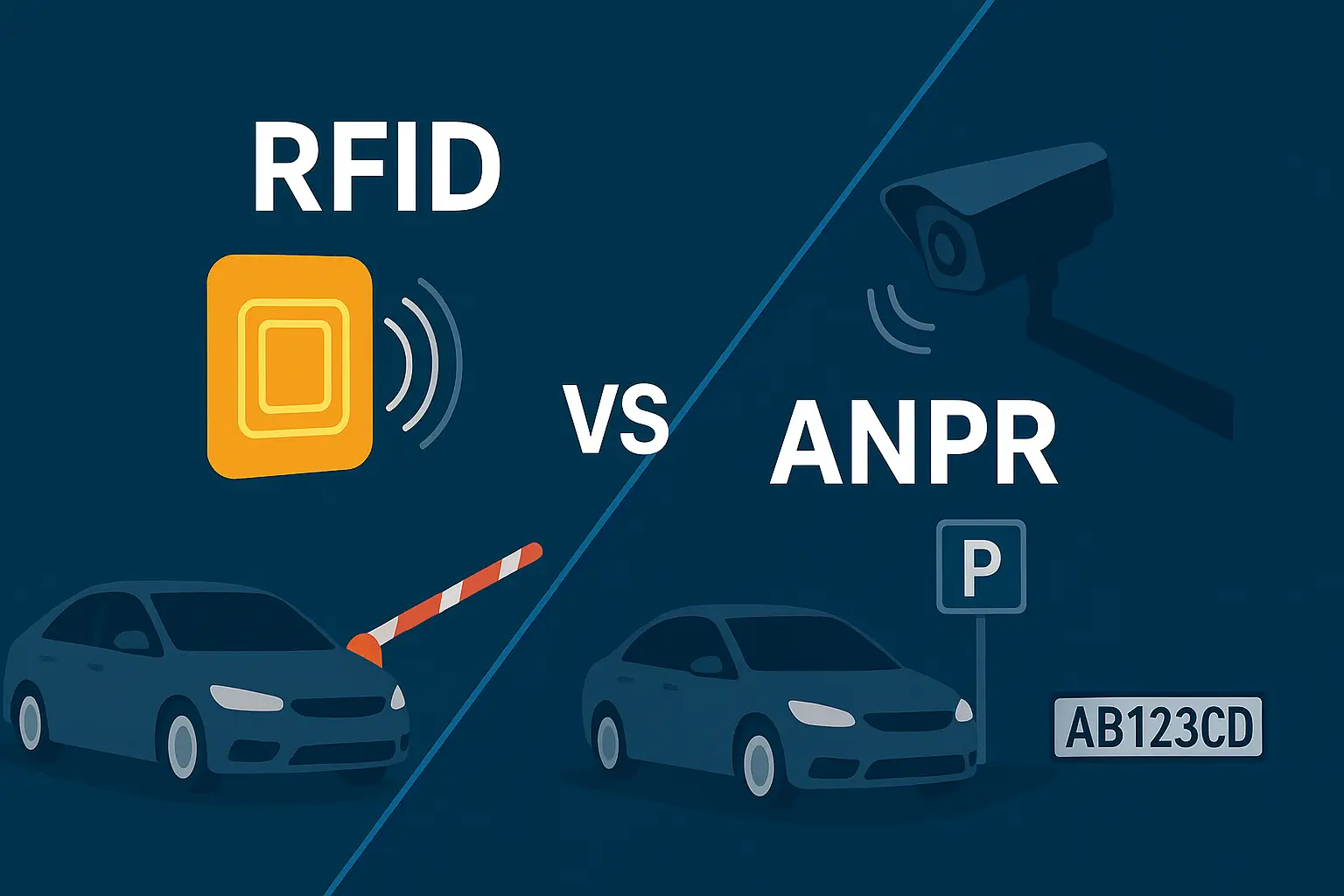
RFID vs ANPR Parking Systems: Which One Is Better Today?

Compare RFID and ANPR parking systems based on cost, accuracy, security, maintenance, and real-world applications to choose the right access control solution for residential societies, commercial properties, hospitals, offices, and mixed-use developments.
RFID vs ANPR: Which Parking Access Control System Is Best for Your Property in 2026?
RFID vs ANPR: Which Is Better?
RFID is usually a better choice for residential societies, employee parking, and locations where the same vehicles enter regularly. ANPR is often better for visitor-heavy environments because vehicles can be identified through their number plates without requiring physical tags. Many modern properties now combine RFID and ANPR to improve security, automate access, and simplify parking operations.
A residential society may have hundreds of registered vehicles entering every day, while a commercial office complex may handle a constant flow of visitors, delivery vehicles, and employees.
In both situations, managing vehicle access manually can quickly become inefficient. Long queues at entry gates, security verification delays, and unauthorized vehicle access are common challenges.
This is why many properties are investing in automated parking access control systems.
However, choosing the right technology is not always straightforward.
Two of the most widely used solutions today are RFID (Radio Frequency Identification) and ANPR (Automatic Number Plate Recognition). Both can automate vehicle entry and improve security, but they work differently and serve different operational needs.
The right choice depends on your property's traffic patterns, security requirements, budget, and long-term goals.
This guide explains how RFID and ANPR work, their advantages, limitations, and which system may be the best fit for your property in 2026.
What Is RFID?
RFID stands for Radio Frequency Identification.
In an RFID parking system, authorized vehicles are issued RFID tags. RFID readers installed near entry and exit points detect these tags and automatically verify vehicle access.
The process typically works as follows:
A vehicle approaches the gate.
The RFID reader detects the tag.
The system verifies authorization.
The boom barrier opens automatically.
Because the process is quick and automated, RFID is commonly used in:
Residential societies
Corporate offices
Educational institutions
Employee parking facilities
Gated communities
RFID works particularly well when the same vehicles use the parking facility regularly.
What Is ANPR?
ANPR stands for Automatic Number Plate Recognition.
Instead of using tags, ANPR relies on cameras and software to identify vehicles through their registration numbers.
The process usually involves:
Capturing the vehicle's number plate.
Reading the registration number through recognition software.
Checking access permissions.
Granting or denying entry.
Because no physical tag is required, ANPR is often preferred in locations where visitors frequently change.
Common applications include:
Commercial complexes
Hospitals
Hotels
Airports
Shopping malls
Business parks
RFID vs ANPR Cost Comparison
Cost is one of the first considerations when evaluating parking access control systems.
Factor | RFID | ANPR |
Initial Cost | Lower | Higher |
Maintenance Cost | Lower | Moderate |
Hardware Required | Tags + Readers | Cameras + Software |
Visitor Handling | Moderate | Excellent |
Scalability | High | High |
RFID
RFID systems generally require:
RFID readers
Vehicle tags
Software integration
Installation
For properties with a large number of regular users, RFID often provides a cost-effective solution.
ANPR
ANPR systems typically require:
High-resolution cameras
Recognition software
Database integration
Supporting infrastructure
The higher technology requirements often result in a larger initial investment.
RFID vs ANPR Accuracy Comparison
Both technologies can provide reliable vehicle identification when properly installed.
RFID Accuracy
RFID identifies vehicles using dedicated tags rather than image processing.
As a result, it generally performs consistently in:
Daylight
Nighttime
Rainy conditions
Dusty environments
ANPR Accuracy
Modern ANPR systems are highly capable, but performance can depend on factors such as:
Lighting conditions
Camera placement
Number plate quality
Dirt or damage on plates
Regular maintenance and proper installation are important for maintaining accuracy.
RFID vs ANPR Security Comparison
Security is another major factor when selecting an access control system.
RFID Risks
Potential concerns include:
Lost tags
Damaged tags
Unauthorized tag sharing
Tag replacement management
ANPR Risks
Potential concerns include:
Poor plate visibility
Dirty or damaged number plates
Camera blind spots
Number plate spoofing attempts
Best Practice
Many high-security properties use both RFID and ANPR together.
RFID verifies the authorized tag, while ANPR verifies the vehicle registration number. This dual-verification approach helps strengthen access control.
RFID vs ANPR for Residential Societies
For most residential communities, RFID is often the preferred option.
Benefits include:
Faster resident access
Lower operational costs
Minimal manual intervention
Easy integration with boom barriers
Simple management of registered vehicles
Example: Residential Society
A gated community with 300 resident vehicles may benefit significantly from RFID because most vehicles enter and exit regularly. Once tags are issued, access becomes quick and predictable.
RFID vs ANPR for Commercial Properties
Commercial properties often have different requirements.
Visitor traffic, delivery vehicles, and temporary access requests are common.
In these environments, ANPR can provide greater flexibility because vehicles do not require pre-issued tags.
Example: Shopping Mall
A shopping mall may receive hundreds of different vehicles every day. ANPR allows vehicle identification without requiring visitors to register for RFID tags in advance.
Future of Parking Access Control in India
Parking technology is evolving rapidly.
Some emerging trends include:
AI-powered ANPR systems
Cloud-based parking management
RFID and ANPR hybrid deployments
Mobile app-based access authorization
Smart city parking integrations
Centralized parking analytics
As parking operations become more automated, hybrid systems are becoming increasingly popular.increasingly automated, hybrid systems are gaining popularity
Which System Should You Choose?
The answer depends on how your property operates.
Requirement | Best Choice |
Residential Society | RFID |
Employee Parking | RFID |
Visitor Parking | ANPR |
Corporate Campus | RFID + ANPR |
High-Security Facility | RFID + ANPR |
Budget-Sensitive Project | RFID |
There is no single solution that works for every property.
The best choice depends on vehicle volume, visitor traffic, security expectations, and operational requirements.
Common Mistakes When Choosing Between RFID and ANPR
Property owners sometimes focus only on technology instead of actual operational needs.
Common mistakes include:
Choosing based solely on price
Ignoring visitor traffic patterns
Overlooking future expansion
Underestimating maintenance requirements
Copying another property's setup without evaluation
Focusing only on hardware instead of overall parking operations
A successful parking system should align with both current and future requirements.
Frequently Asked Questions
Is RFID cheaper than ANPR?
In many cases, RFID systems involve lower deployment costs because they require fewer advanced hardware components.
Is ANPR more secure than RFID?
Both technologies can provide strong security. Many high-security facilities use both systems together for additional verification.
Which system is better for apartments?
RFID is often preferred because residents typically use the same vehicles daily.
Can ANPR work without RFID tags?
Yes. ANPR identifies vehicles using registration plates and does not require physical tags.
Can RFID and ANPR be used together?
Yes. Many modern parking facilities use RFID for residents and ANPR for visitors.
Need Help Choosing Between RFID and ANPR?
Every property has unique parking and security requirements.
A residential society, hospital, commercial complex, corporate office, or industrial facility may require a completely different access control strategy.
Before investing in any parking technology, evaluate vehicle traffic, visitor management needs, security expectations, and future expansion plans.
Parksmart helps organizations assess these requirements and identify the most suitable parking access control solution for long-term operational efficiency.
Also read→
Boom Barriers: Types, Features, Prices, and Applications
Conclusion
RFID and ANPR are both effective parking access control technologies, but they are designed for different situations.
RFID is often ideal for residential societies, employee parking, and locations with regular vehicle movement. ANPR is frequently a better fit for visitor-heavy environments where tag-free vehicle identification is preferred.
For many modern properties, the most practical solution is not choosing one over the other—but combining both technologies to create a smarter, more secure, and more efficient parking experience.
If you are planning a new parking project or upgrading an existing system, choosing the right access control technology today can improve security, reduce manual effort, and support future growth for years to come.
RFID vs ANPR: Which Parking Access Control System Is Best for Your Property in 2026?
RFID vs ANPR: Which Is Better?
RFID is usually a better choice for residential societies, employee parking, and locations where the same vehicles enter regularly. ANPR is often better for visitor-heavy environments because vehicles can be identified through their number plates without requiring physical tags. Many modern properties now combine RFID and ANPR to improve security, automate access, and simplify parking operations.
A residential society may have hundreds of registered vehicles entering every day, while a commercial office complex may handle a constant flow of visitors, delivery vehicles, and employees.
In both situations, managing vehicle access manually can quickly become inefficient. Long queues at entry gates, security verification delays, and unauthorized vehicle access are common challenges.
This is why many properties are investing in automated parking access control systems.
However, choosing the right technology is not always straightforward.
Two of the most widely used solutions today are RFID (Radio Frequency Identification) and ANPR (Automatic Number Plate Recognition). Both can automate vehicle entry and improve security, but they work differently and serve different operational needs.
The right choice depends on your property's traffic patterns, security requirements, budget, and long-term goals.
This guide explains how RFID and ANPR work, their advantages, limitations, and which system may be the best fit for your property in 2026.
What Is RFID?
RFID stands for Radio Frequency Identification.
In an RFID parking system, authorized vehicles are issued RFID tags. RFID readers installed near entry and exit points detect these tags and automatically verify vehicle access.
The process typically works as follows:
A vehicle approaches the gate.
The RFID reader detects the tag.
The system verifies authorization.
The boom barrier opens automatically.
Because the process is quick and automated, RFID is commonly used in:
Residential societies
Corporate offices
Educational institutions
Employee parking facilities
Gated communities
RFID works particularly well when the same vehicles use the parking facility regularly.
What Is ANPR?
ANPR stands for Automatic Number Plate Recognition.
Instead of using tags, ANPR relies on cameras and software to identify vehicles through their registration numbers.
The process usually involves:
Capturing the vehicle's number plate.
Reading the registration number through recognition software.
Checking access permissions.
Granting or denying entry.
Because no physical tag is required, ANPR is often preferred in locations where visitors frequently change.
Common applications include:
Commercial complexes
Hospitals
Hotels
Airports
Shopping malls
Business parks
RFID vs ANPR Cost Comparison
Cost is one of the first considerations when evaluating parking access control systems.
Factor | RFID | ANPR |
Initial Cost | Lower | Higher |
Maintenance Cost | Lower | Moderate |
Hardware Required | Tags + Readers | Cameras + Software |
Visitor Handling | Moderate | Excellent |
Scalability | High | High |
RFID
RFID systems generally require:
RFID readers
Vehicle tags
Software integration
Installation
For properties with a large number of regular users, RFID often provides a cost-effective solution.
ANPR
ANPR systems typically require:
High-resolution cameras
Recognition software
Database integration
Supporting infrastructure
The higher technology requirements often result in a larger initial investment.
RFID vs ANPR Accuracy Comparison
Both technologies can provide reliable vehicle identification when properly installed.
RFID Accuracy
RFID identifies vehicles using dedicated tags rather than image processing.
As a result, it generally performs consistently in:
Daylight
Nighttime
Rainy conditions
Dusty environments
ANPR Accuracy
Modern ANPR systems are highly capable, but performance can depend on factors such as:
Lighting conditions
Camera placement
Number plate quality
Dirt or damage on plates
Regular maintenance and proper installation are important for maintaining accuracy.
RFID vs ANPR Security Comparison
Security is another major factor when selecting an access control system.
RFID Risks
Potential concerns include:
Lost tags
Damaged tags
Unauthorized tag sharing
Tag replacement management
ANPR Risks
Potential concerns include:
Poor plate visibility
Dirty or damaged number plates
Camera blind spots
Number plate spoofing attempts
Best Practice
Many high-security properties use both RFID and ANPR together.
RFID verifies the authorized tag, while ANPR verifies the vehicle registration number. This dual-verification approach helps strengthen access control.
RFID vs ANPR for Residential Societies
For most residential communities, RFID is often the preferred option.
Benefits include:
Faster resident access
Lower operational costs
Minimal manual intervention
Easy integration with boom barriers
Simple management of registered vehicles
Example: Residential Society
A gated community with 300 resident vehicles may benefit significantly from RFID because most vehicles enter and exit regularly. Once tags are issued, access becomes quick and predictable.
RFID vs ANPR for Commercial Properties
Commercial properties often have different requirements.
Visitor traffic, delivery vehicles, and temporary access requests are common.
In these environments, ANPR can provide greater flexibility because vehicles do not require pre-issued tags.
Example: Shopping Mall
A shopping mall may receive hundreds of different vehicles every day. ANPR allows vehicle identification without requiring visitors to register for RFID tags in advance.
Future of Parking Access Control in India
Parking technology is evolving rapidly.
Some emerging trends include:
AI-powered ANPR systems
Cloud-based parking management
RFID and ANPR hybrid deployments
Mobile app-based access authorization
Smart city parking integrations
Centralized parking analytics
As parking operations become more automated, hybrid systems are becoming increasingly popular.increasingly automated, hybrid systems are gaining popularity
Which System Should You Choose?
The answer depends on how your property operates.
Requirement | Best Choice |
Residential Society | RFID |
Employee Parking | RFID |
Visitor Parking | ANPR |
Corporate Campus | RFID + ANPR |
High-Security Facility | RFID + ANPR |
Budget-Sensitive Project | RFID |
There is no single solution that works for every property.
The best choice depends on vehicle volume, visitor traffic, security expectations, and operational requirements.
Common Mistakes When Choosing Between RFID and ANPR
Property owners sometimes focus only on technology instead of actual operational needs.
Common mistakes include:
Choosing based solely on price
Ignoring visitor traffic patterns
Overlooking future expansion
Underestimating maintenance requirements
Copying another property's setup without evaluation
Focusing only on hardware instead of overall parking operations
A successful parking system should align with both current and future requirements.
Frequently Asked Questions
Is RFID cheaper than ANPR?
In many cases, RFID systems involve lower deployment costs because they require fewer advanced hardware components.
Is ANPR more secure than RFID?
Both technologies can provide strong security. Many high-security facilities use both systems together for additional verification.
Which system is better for apartments?
RFID is often preferred because residents typically use the same vehicles daily.
Can ANPR work without RFID tags?
Yes. ANPR identifies vehicles using registration plates and does not require physical tags.
Can RFID and ANPR be used together?
Yes. Many modern parking facilities use RFID for residents and ANPR for visitors.
Need Help Choosing Between RFID and ANPR?
Every property has unique parking and security requirements.
A residential society, hospital, commercial complex, corporate office, or industrial facility may require a completely different access control strategy.
Before investing in any parking technology, evaluate vehicle traffic, visitor management needs, security expectations, and future expansion plans.
Parksmart helps organizations assess these requirements and identify the most suitable parking access control solution for long-term operational efficiency.
Also read→
Boom Barriers: Types, Features, Prices, and Applications
Conclusion
RFID and ANPR are both effective parking access control technologies, but they are designed for different situations.
RFID is often ideal for residential societies, employee parking, and locations with regular vehicle movement. ANPR is frequently a better fit for visitor-heavy environments where tag-free vehicle identification is preferred.
For many modern properties, the most practical solution is not choosing one over the other—but combining both technologies to create a smarter, more secure, and more efficient parking experience.
If you are planning a new parking project or upgrading an existing system, choosing the right access control technology today can improve security, reduce manual effort, and support future growth for years to come.

Increase Efficiency, Maximize Profit
ParkSmart smart parking solutions optimize operations, reduce costs, and boost revenue. With automated access control, payment systems, and space management, we help you streamline processes and enhance profitability. Maximize your parking potential with ParkSmart today.
+
Cars Managed by ParkSmart
+
Transactions Processed Daily
+
Parking Locations Integrated
+
Satisified Users
Increase Efficiency, Maximize Profit
ParkSmart smart parking solutions optimize operations, reduce costs, and boost revenue. With automated access control, payment systems, and space management, we help you streamline processes and enhance profitability. Maximize your parking potential with ParkSmart today.
+
Cars Managed by ParkSmart
+
Transactions Processed Daily
+
Parking Locations Integrated
+
Satisified Users
Increase Efficiency, Maximize Profit
ParkSmart smart parking solutions optimize operations, reduce costs, and boost revenue. With automated access control, payment systems, and space management, we help you streamline processes and enhance profitability. Maximize your parking potential with ParkSmart today.